
Signal failure
Book lists, 70s film photography, interplanetary elephants, etc.

Year-end book lists. Best-of lists. I have some thoughts on the form, most of which were better articulated by Pete Tosiello in his latest post. I read a lot of books, but never come up with lists largely because I don’t keep track of what I’ve read in any given year. I’m also not an influencer so I’ve never bothered with affiliate links, which I suppose might make it worth one’s time to stuff a bunch of titles together in a post and receive some cut if people purchase any of them. I won’t deny that it’s lovely to appear on these annual lists if you’ve published a book that year. And yet . . . “Best” – we all know what it means but it’s one of those words that sets off, the more you think about it, a semantic spiral. Perhaps an existential one, too.
If I were to post a Best of What I Read in 2025, it would have to include 1977’s The Little Lamb – story by Judy Dunn, photographs by Phoebe Dunn – a book from my childhood that resurfaced in my home early last year. Finding it and opening it, I experienced what people on the internet refer to in meme-speak as “core memory unlocked.”


A girl named Emmy cares for a mischievous lamb named Timothy. She makes dandelion crowns for the two of them. (“The only trouble was – Timothy ate the dandelions.”) They play hide and seek, Timothy knocks over a bushel of apples, they go to a birthday party. All of it is captured in 1970s sun-and-shadow film photography. And Emmy’s clothes! It hit me that I always aspired to dress like Emmy, her sweatshirts, sneakers, her party dress – and often still do.
Relatedly, in 2024 I found an old copy of Babar Visits Another Planet. I’d read it as a child and had long been haunted by an image of Babar stepping out of a spaceship and onto a gooey planet, losing his black dress shoe. “Haunted” gives that experience an eerie cast and is maybe not the right word. It was more dream-like. A dream-image you keep returning to and it occurred to me that I could find the book online, order it, and see how the reality related to the dream. (Yes, Babar is a “problematic fave” and I don’t want to dismiss the valid critiques of the series, but at the same time, I’m interested in the return to images and narratives that lodged themselves in a child’s mind, however fuzzy or faded they may have become over the years.)
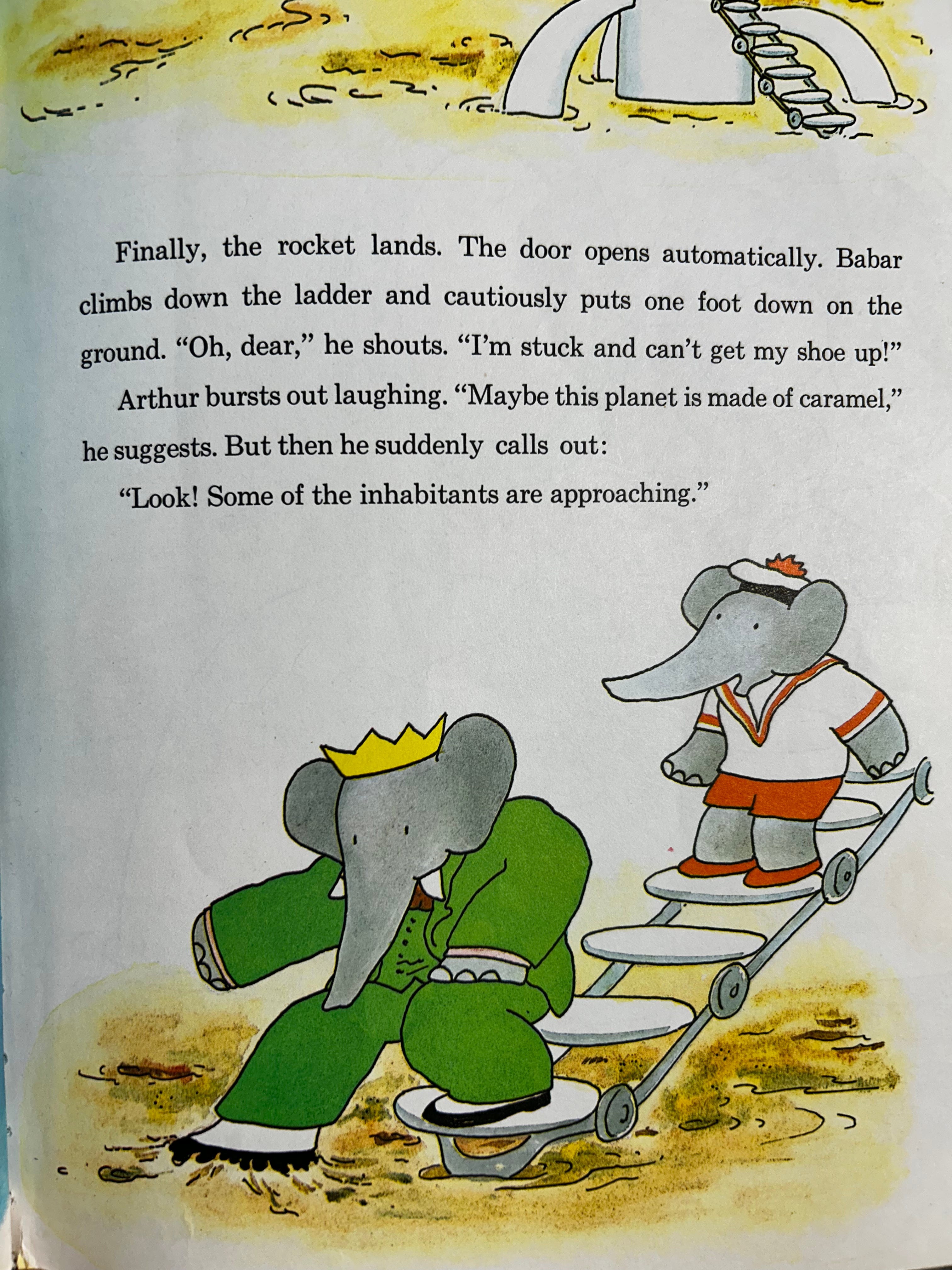
In this story, Babar and his family are having a picnic when they’re sucked up into a rocket ship that takes them into space. They land on a planet of smaller, curly-eared pachyderms whose feel for architectural, interior, and industrial design is astounding.
Babar’s shoe is lost to the planet’s sticky surface; at one point he goes to a supermarket that sells footwear, but nothing is large enough for his feet, so he decides to take off his other shoe and go around in his dotted green socks as it “will be more elegant.”
The French writer Nathalie Sarraute explored the phenomenon of image-memories that resurface – specifically via illustrations in books – in her 1983 memoir Childhood, which she wrote in her early eighties. She refers to an edition of Mark Twain’s The Prince and the Pauper: “I don’t think there was any other book in my childhood that I lived in as I lived in that one.” She lived specifically in two images – “two furrows which two images, and those two alone, ploughed . . .” The images are of Edward, the prince in pauper’s clothing, being ridiculed, and Tom, the pauper in royal finery, being waited on. She writes:
“It is curious that, although I read this book over and over again, everything about it should have vanished except for these images, which still remain as intense, as intact.”
Sarraute’s novels can be challenging to love but Childhood is so accessible and moving on the subjects of time and memory. I wrote about this particular passage in my latest book, Watching the Detective, as it concerns the sensations, whispers, images, and half-thoughts of childhood that are formative yet elusive as we age. For me, this interest has less to do with nostalgia – often a kind of regressive, faintly embarrassing yearning – and more with being-a-person-in-time. Less about an idealized past, more about recognizing a continuum.
In addition to Babar Visits Another Planet, I tracked down a copy of another book whose images ploughed furrows. A book about Nadia Comeneci, part of a series called Sports Star, that also included books on Pelé, “Mean” Joe Greene, Chris Evert, Walt Frazier, Dorothy Hamill, and the like.
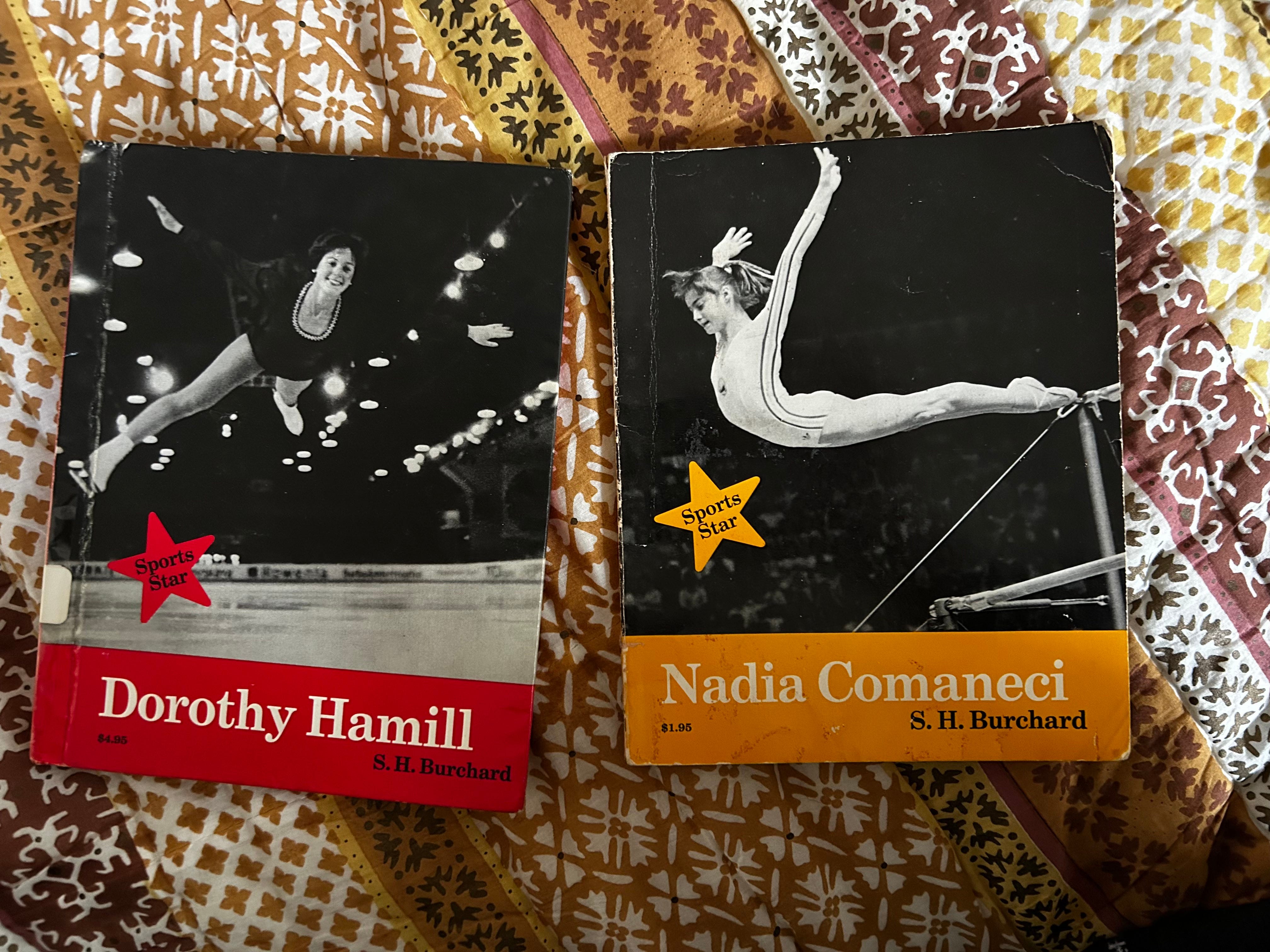
Last October I went to a Halloween party. The theme: Dress as your childhood idol. Easy. Nadia. Olympics champion at the Montreal games in 1976. So renowned that somehow children (e.g. me) who came into the world after she achieved the first ever perfect 10 score in gymnastics – a score so unprecedented the scoreboard couldn’t properly register it – still read books about her, still wanted to be like her. (It would be years before abusive coaching practices in gymnastics became part of the public consciousness; they definitely weren’t mentioned in my Nadia book).
In the Sports Star series, all the photographs are black and white. So my memory of Nadia, in that period, is in black and white. For my costume, I used black electrical tape to fashion the diagonal stripes and lettering on a white track jacket, basing it on a photo, from the book, of Nadia on a medal podium. I also bought fake bangs. Days after the party, I saw another photo of a medal ceremony only it was in color. And the stripes on Nadia’s uniform were blue, red, and yellow. I had never thought to question the color of the black and white image that was fixed in my mind, which must have been bolstered by an unexamined assumption that in Soviet-era Romania they somehow didn’t have color??? (I know.)


I’m not sure a lot of people born after, say, 1990 recognize Nadia now, certainly not instantly as an icon. I had to explain the costume to my neighbors, who have two young daughters, girls who decades ago would likely have been Nadia fans, taking gymnastics classes on Saturday mornings, whether they were good at the sport or not.
I understand, intellectually, that as time passes, so do cultural references; the actual experience of that on an emotional level, though, continues to wound. The alienation of aging. I often think about this passage in Mary Gaitskill’s novel, Veronica, in which the narrator’s father uses music to connect with people, to embody feelings, as a kind of emotional shorthand.
“But eventually those feelings got attached to other songs, and those singers didn’t work as signals anymore. I remember being there once when he was playing the songs for some men he worked with, talking excitedly about the music. He didn’t realize his signals could not be heard, that the men were looking at him strangely. Or maybe he did realize but didn’t know what else to do but keep signaling.”
As a young person, the narrator thinks her father is ridiculous. “I didn’t see that I was making the same mistake.”
By the way, Veronica came out in 2005. I think I first read it a couple of years after that. If I did make annual favorite lists, it would probably be on my 2025 edition, too. Sometimes you just keep signaling.
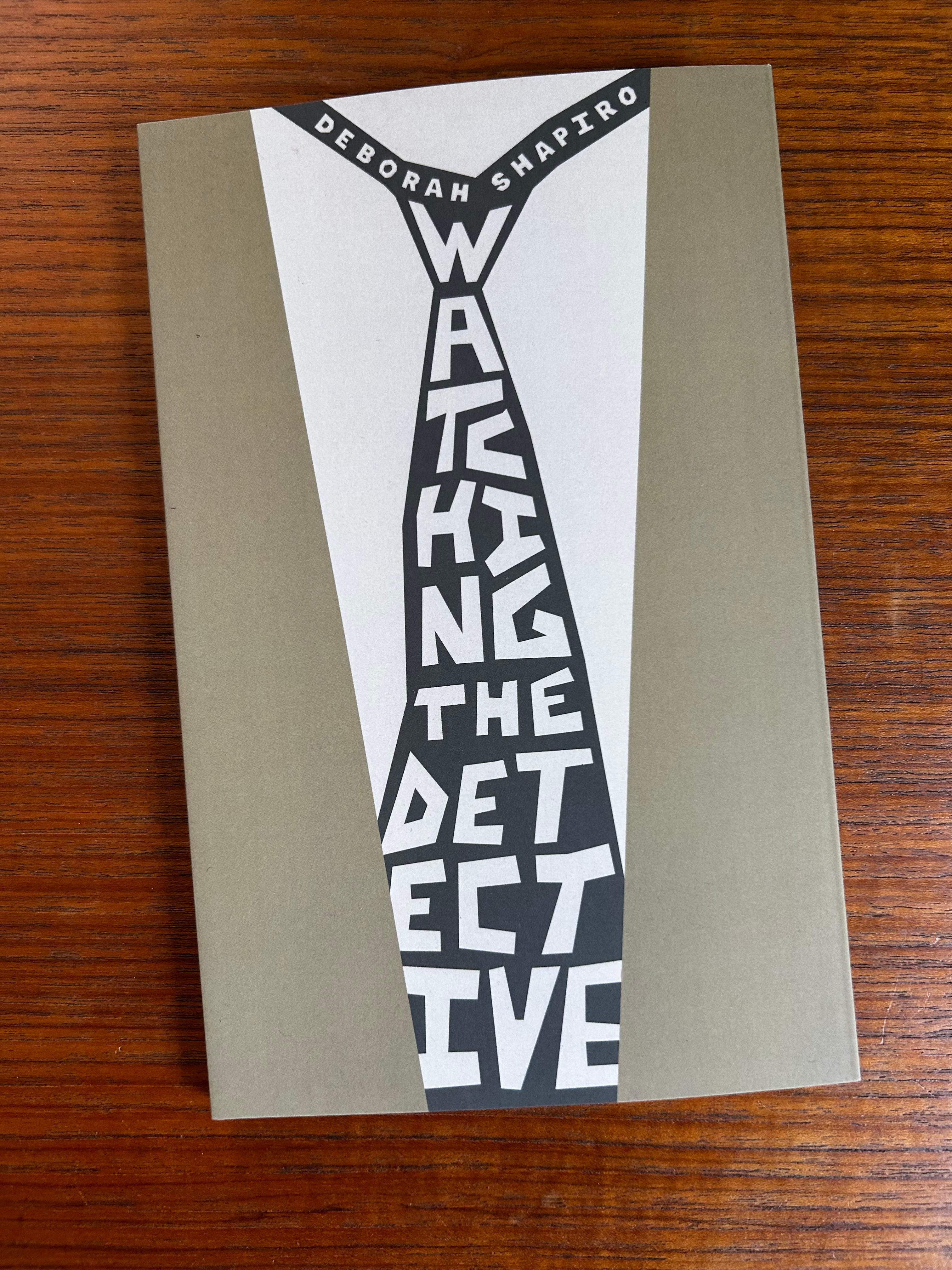
My new book, Watching the Detective, is available to purchase here and here and at select bookstores. It has appeared on a few lists!
Veronica! Yes!